
History
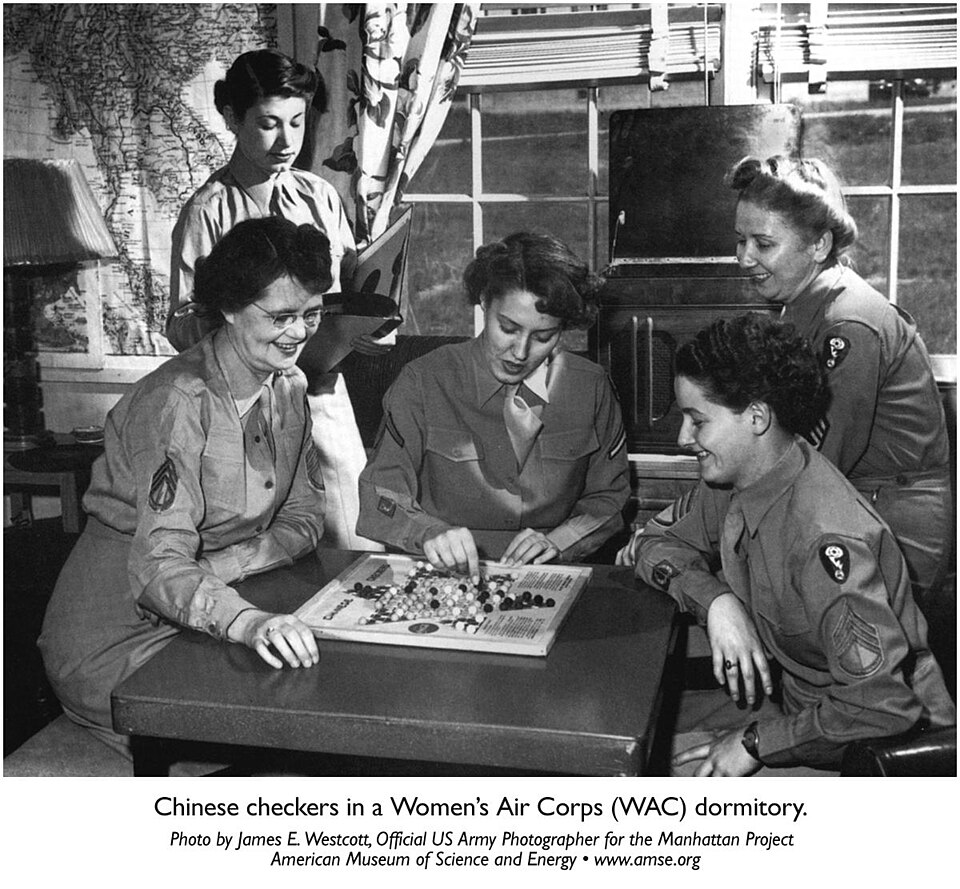
The name “Chinese Checkers” is a bit of a misnomer, as this game is not Chinese, nor is it a version of checkers. It was invented in Germany in 1892. The original name of the game was “Sternhalma” – Stern is German for star, and Halma (Greek for jump) is the name of the American game that it was based on.
The game was introduced to the United States by the Pressman Toy Corporation in 1920 under a name we would now consider problematic: “Hop Ching Checkers.” It was renamed “Chinese Checkers” in 1928. This name and the accompanying backstory were invented to capitalize on the popularity of eastern cultures at the time.
Today, the game is played in China, but it was introduced to them via Japan.
How to play
Objective
The goal is to move all of your pieces to the triangle on the opposite side of the board from where they started.
Setup
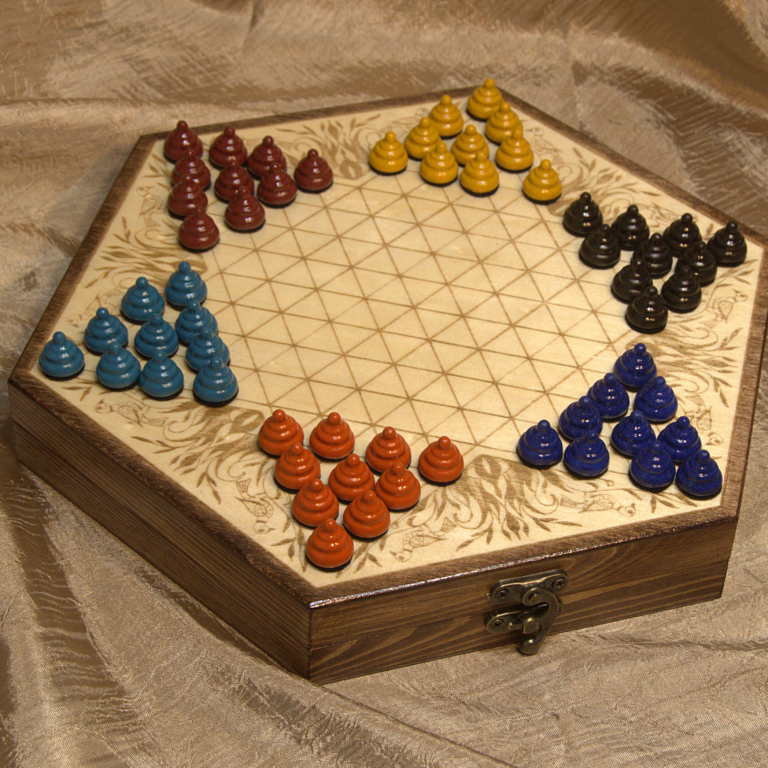
Each player starts by placing their 10 pieces in the triangle (point of the star) that is closest to them. Each piece will be placed on the intersections within that triangle. Where the players sit will depend on how many players you have.
6 players: Players sit around the board, each occupying one point of the star.
4 players: Players sit opposite each other so that the 2 empty points are also opposite each other.
3 players: There are 2 variations on the 3 player game that you can choose from. In one variation each player controls two sets of pieces on opposite points of the star. In the other version, players will each use only one set and sit so that the point opposite them is empty.
2 players: You may play with 1 set, 2 sets or 3 sets. If each player has 1 set or 3 sets, the pieces will be set up opposite their opponent. With 2 sets, players will set up their pieces so that they are playing opposite themselves.
General Rules
Each player takes turns moving one of their pieces along the lines of the board to an empty space (intersection). A piece can move either to an adjacent empty intersection, or may jump over another piece (including your own) in a straight line to a space directly opposite that piece. You can only hop one piece in a single jump, but you may chain jumps together to move multiple spaces. Pieces are not captured when you jump over them. All pieces remain on the board throughout the game.
Once a piece has reached the triangle on the opposite side it may not be moved out of the triangle. Pieces cannot land in any triangles other than your starting triangle and the one opposite you. You can jump through other triangles, but you can’t complete a turn with your piece there.
If there are no available spaces on the opposite triangle because spaces are blocked by your opponent, once your piece is adjacent to the triangle and you have no other moves available, you may swap places with your piece and the opponent’s piece.
Declaring the Winner
- The game is won when a player has moved all of their pieces into the triangle on the opposite side of the board.
- In games with 3 or more player, you can optionally continue playing to compete for 2nd place, 3rd place etc.