
History
Puluc was first played in Guatemala by the indigenous Qʼeqchiʼ (Kekchi)
people, prior to the Spanish Conquest. Unfortunately, as with many other Mayan groups, much of the pre-colonial history of Qʼeqchiʼ people has been lost, but this game has survived and evolved into modern variants that are still played by the Qʼeqchiʼ today. Boards can range in the number of spaces, but they’re almost always an odd number, usually 7, 9, or 11.
The original rules have been lost to history, however archaeologists and historians have presented some potential variations of rules that are their best guess of how it could have been played over 500 years ago. This is just one of those variants, but there are others out there that you can also try with this set.
How to play
Overview
The premise of the game is a battle between two groups of warriors. Each player has a village at either end, and the spaces between are the territory in conflict.
Players attempt to capture each other’s warriors and bring them back to their village, while also rescuing their own captured warriors before they are taken to the enemy base to be prisoners forever.
Parts
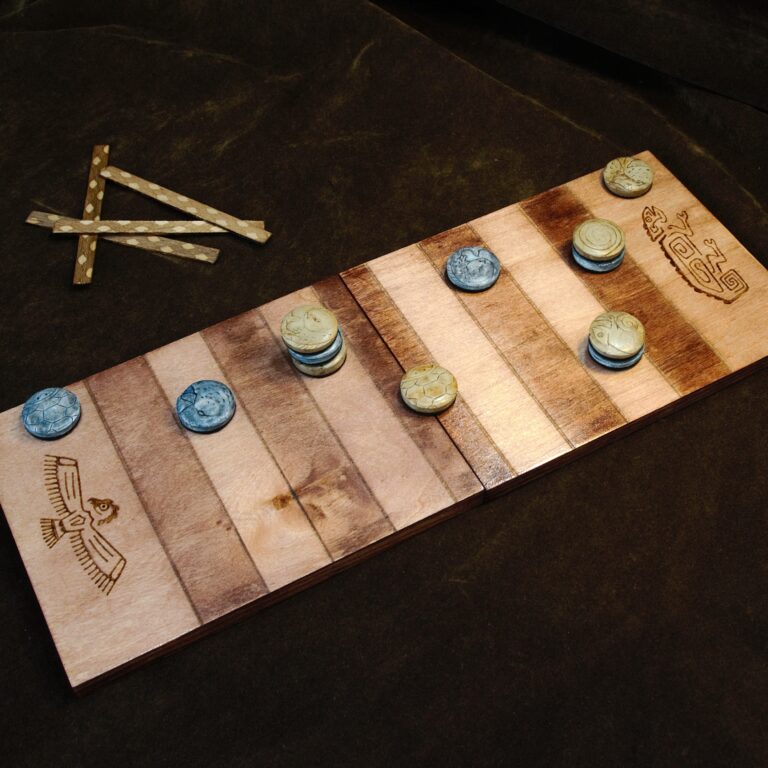
- The board: The board consists of several rectangular bars which serve as the game spaces, and two larger rectangles at either end which represent a player's village (home).
- Game pieces: Each player has discs which represent their warriors typically 5 for each player.
- 4 Throwing Sticks: In ancient times people used throwing sticks or marked beans or corn to determine the number of spaces, you could also use dice if you prefer.
Setup
Each player places their pieces at their corresponding home base. Have each player drop the casting sticks. The player with the most pattern-side up goes first. (If you’re using dice, have the player with the highest roll go first)
During Your Turn
- Hold the casting sticks vertically and drop them to the table. The number of sticks shown with the decorated side up determines how many spaces to move
1 stick = 0 spaces
2 sticks = 2 spaces
3 sticks = 3 spaces
4 sticks = 4 spaces
0 sticks = 5 spaces
- You can choose to move a piece from your home base onto the 1st space of the board, or move a piece that is already on the board.
- You cannot land on a space that is already occupied by one of your own pieces.
- You cannot land on your opponent's base.
- There is no limit to the number of pieces you can have on the board at one time.
- Your piece can move in either direction, but you cannot change direction mid-turn.
- If you are unable to move any pieces, your turn is forfeit.
Capture & Rescue
- If you land on a space occupied by the other player, place your piece on top of the other player's piece. You now control this “stack”. This is how pieces are captured and rescued.
- Players can land on their opponent's stack to re-capture it. A stack can be re-captured any number of times. The piece on top indicates which player is in control of the stack.
- There is no limit to how many pieces can be in a stack.
- Once you capture a stack, the goal is to take it back to your home base.
- When you reach your base: The other player's pieces are your prisoners now and can not be rescued. Any of your own pieces are placed back in your home base and are ready to be used again in your subsequent turns.
Declaring the Winner
The game is over when one player has taken all of the other player’s warriors back to their home base as prisoner.
*Note: this can occasionally lead to a very long game, so you may optionally choose a specific number of pieces to be captured before starting for a shorter game.
A note on the accuracy of historic game rules:
Most ancient games and historic games were originally taught by word of mouth, so there can be many different interpretations to the rules. This is just one version that you can play. There are other variations that you can try until you find your favorite, but this will get you started. Just make sure that when you play with other people who are familiar with the game, you agree on a set of rules before you start to avoid any hard feelings.