
Byzantine Chess
History & How to Play
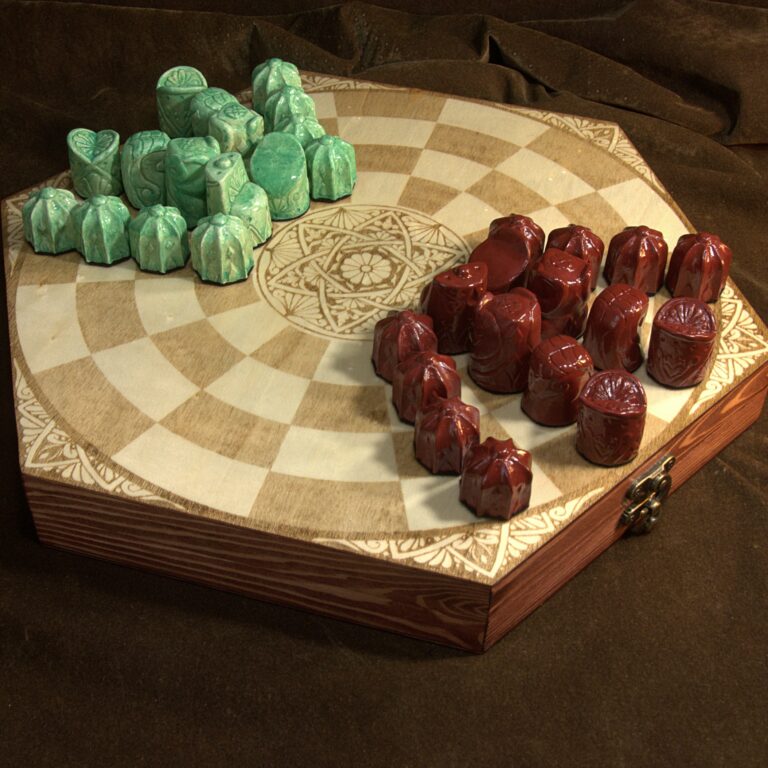
History
Chess has a long history of nearly 1500 years. But it wasn’t always the game we know today. It is believed to have its most ancient roots in India with a game called Chaturanga. Throughout history, as it was shared and taught to different people as it traveled throughout the Middle East and Europe, variations were adapted for this game until it eventually became the game we know today. But this evolution wasn’t a straight line. There were many regional variants that would branch off in new directions. Byzantine or Circular Chess is one of those unique adaptations.
The Byzantine Empire (which was then known as the Eastern Roman Empire) also has a very long history, spanning 330 BCE to 1445 CE. It was centered around its capital, Constantinople – today known as Istanbul. It was an economic crossroads, situated along the silk road, and was essentially the gateway between Europe, the Middle East, and Asia. They would have had an exchange of ideas and goods from all over the western hemisphere, and games were no exception. In fact, games were often brought to new places by tradespeople and travelers, not necessarily as goods, but as personal possessions to keep themselves and their traveling companions entertained along the journey. They were not so different from modern travelers, who bring a pack of cards in a carry-on, or keep a magnetic chess set in the car to distract their children on a long road trip.
Around the 9th century CE, when Byzantine Chess emerged, the Byzantines were familiar with Chaturanga, which they called Zatrikion. In addition to the traditional square 8×8 version, they also created a circular variation. This alternate game uses the same number of squares but they are situated in 4 rings. This new shape required new strategies.
The pieces they used had a different set of characters from the chess we know today. Elephants instead of bishops, a counselor or vizier instead of a queen, and the knight would have been just a horse – representing a cavalry. The rook was called “rukh”, the Persian word for chariot. These pieces also had slight differences in the way they move, which we’ll discuss in the rules section later on.
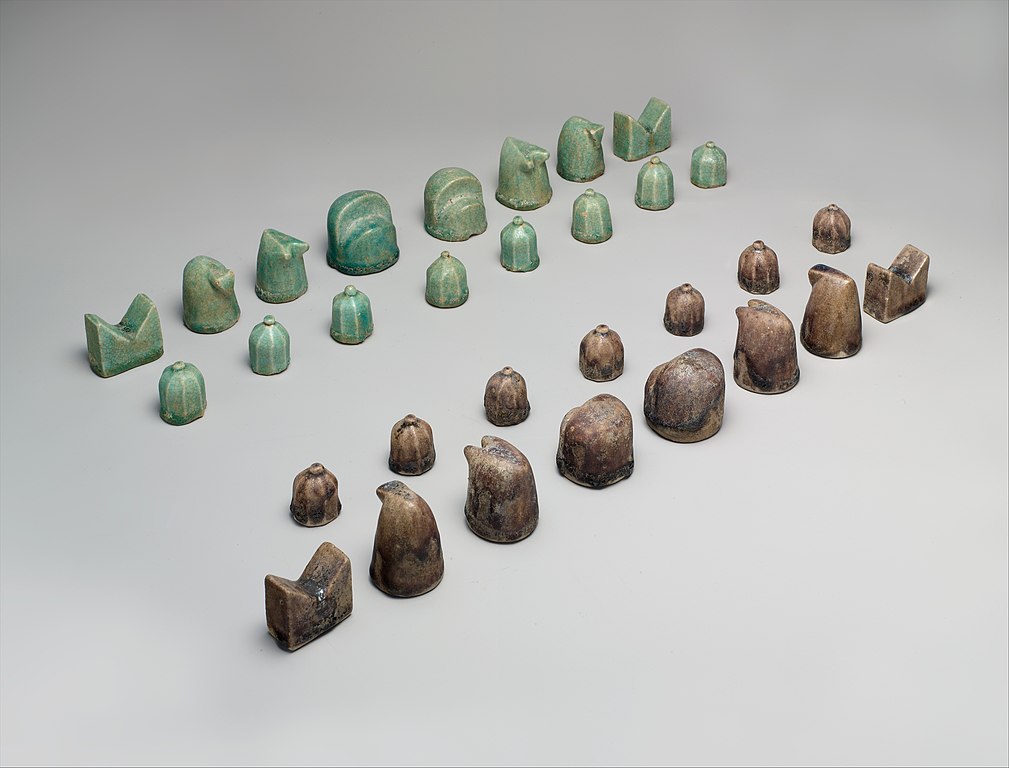
Zatrikion was likely introduced to the Byzantines via merchants from Persia (who called the game Shatranj). Many of the chess artifacts that are attributed to the Byzantines have abstract game piece designs that resemble those found in Persia, rather than the ornate realistic carvings that were prominent in India. These more abstract designs emerged when Islam became more dominant in Persia, as it would have been inappropriate to use realistic carvings of people and animals. At this time, Constantinople would likely have had exposure to goods from both India and Persia, so it’s possible that they would have been aware of the two different styles but chose more abstract pieces deliberately because of the ongoing Iconoclasm in the Christian Byzantine Empire. This was a period of time where religious images and statues were banned and destroyed to avoid icon worship. While chess was not a religious game, it’s possible that artisans were influenced by this, and wouldn’t have wanted to risk the devastation of having their work destroyed.
Today there is also a modern version of circular chess where the movements of the game pieces correspond to modern chess. This version was adapted in 1983 by historian David Reynolds.
How to play
Objective
As in modern chess, the goal of the game is to checkmate the king, making your opponent unable to move the king, or remain in place without being captured.
Setup
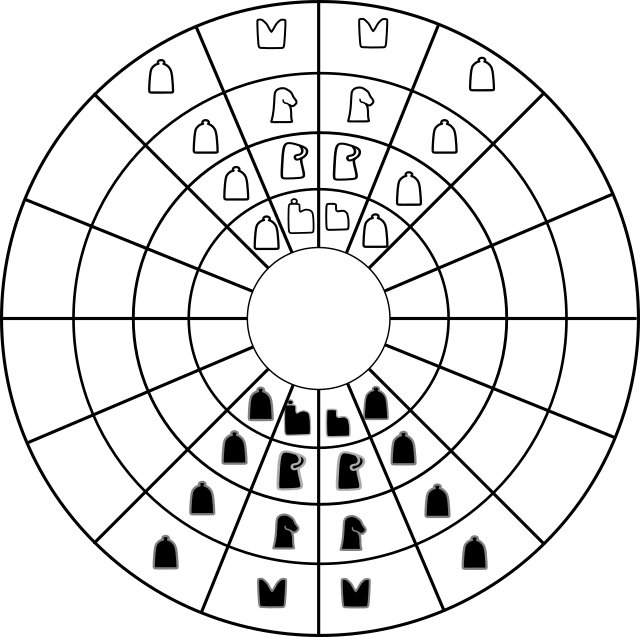
Set up the pieces according to the diagram. Each player will be exactly opposite each other with their pieces in 4 columns . The middle 2 columns will hold the king and vizier closest to the center, followed by the elephants, then horses, then the chariot.
The pawns will fill the outer two rows surrounding the higher ranking pieces.
Game Pieces
You can use either a modern set of chess pieces, or a Zatrikion/Shatranj or Chaturanga set. Use the table to see how the pieces relate to each other.

Game Play
Note: Modern chess rules such as castling, and special captures such as “en passant” capture do not apply.
- Each player takes turns moving one of their pieces.
- Each piece moves in a unique way described in the table in the setup section.
- When a piece lands on an opponent’s piece, that piece is captured and removed from the board.
- If a pawn passes the opposite side of the board where the opponent’s pawns started, the pawn gets promoted to Vizier.
- If two of a players pawns have reached each other on opposite sides of the board and are unable to move further, that player may choose to remove both pawns.
Declaring the Winner
- If a player is unable to move their king without putting him in check (without putting it in a spot where it could be captured) the game is over and the opponent is the winner.
- If neither player is able to make a move (stalemate) the last player to have moved is the winner.
- If a player is left with only their king left, they lose the game, unless they are able to reduce their opponent to only one king in their next turn.
Modern Variation
Modern circular chess was invented 1983 by historian David Reynolds as a hybrid of Byzantine chess and modern rules. Game play follows modern chess rules and pieces move as they would in modern chess. There are still a few acceptions however that prevent akward scenarios: “en passant” capture is not allowed, and castling is not allowed. Pieces are also not allowed to make any maneuvers that would move them back to their original position. For example, a rook cannot move in a full circle around the board.
A note on the accuracy of historic game rules:
Most ancient games and historic games were originally taught by word of mouth, so there can be many different interpretations to the rules. This is just one version that you can play. There are other variations that you can try until you find your favorite, but this will get you started. Just make sure that when you play with other people who are familiar with the game, you agree on a set of rules before you start to avoid any hard feelings.