
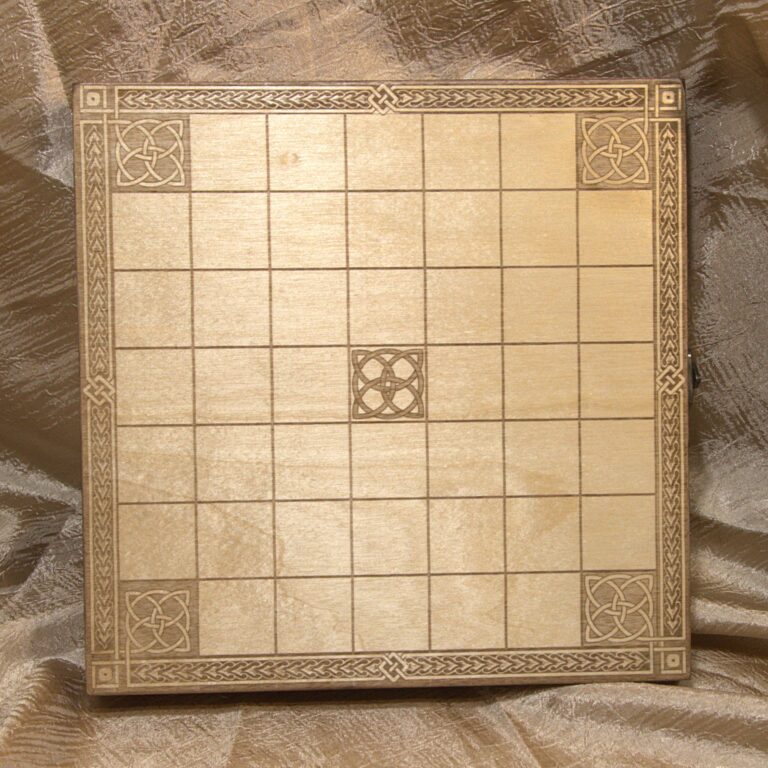
History
Brandubh is a game from Ireland that evolved from Norse Hnefatafl games. Hnefatafl was first introduced to the region around 900AD when the Vikings arrived in Ireland. Hnefatafl boards come in a variety of sizes up to 15×15 squares. However the artifacts that have been found in Ireland are mostly smaller with 7×7 grids.
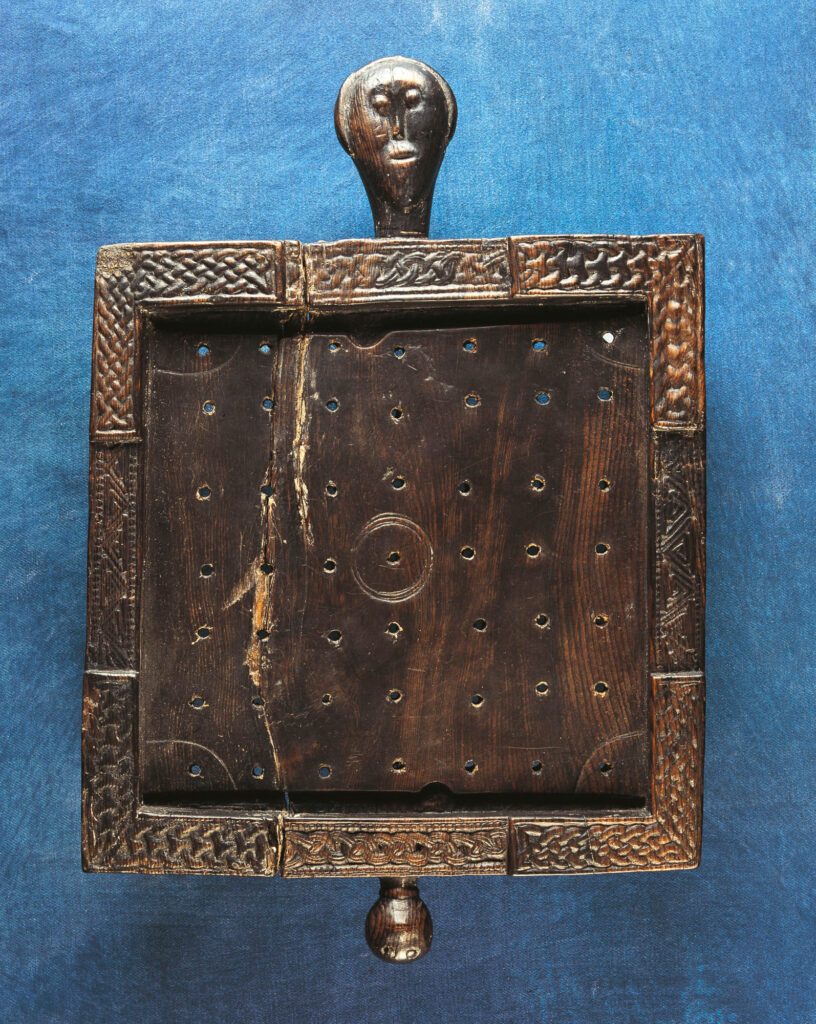
Game sets have been found all over Ireland including Downpatrick and Waterford, but the most famous of these 7×7 boards discovered is dubbed the Ballinderry board, nicknamed for the location it was found, a 9th to 11th century settlement. This wooden board featured peg holes rather than the usual grid, and was ornately decorated with knotwork and carvings.
The settlement at Ballinderry was likely home to Irish nobility, however several Viking artifacts have been found there including jewelry and weapons that may have been acquired through trade. While the Vikings arrived as raiders and occupiers, by the 11th century, the cultures had begun to merge. Brandubh is one piece of daily life that was born out of this integration.
How to play
Objective
Each Player has a different objective. As the King player, your objective is to get your king from the center “throne” to one of the four corners of the board without the king being captured. As the attacking or offensive player, your goal is to capture the king before he can escape.
Setup
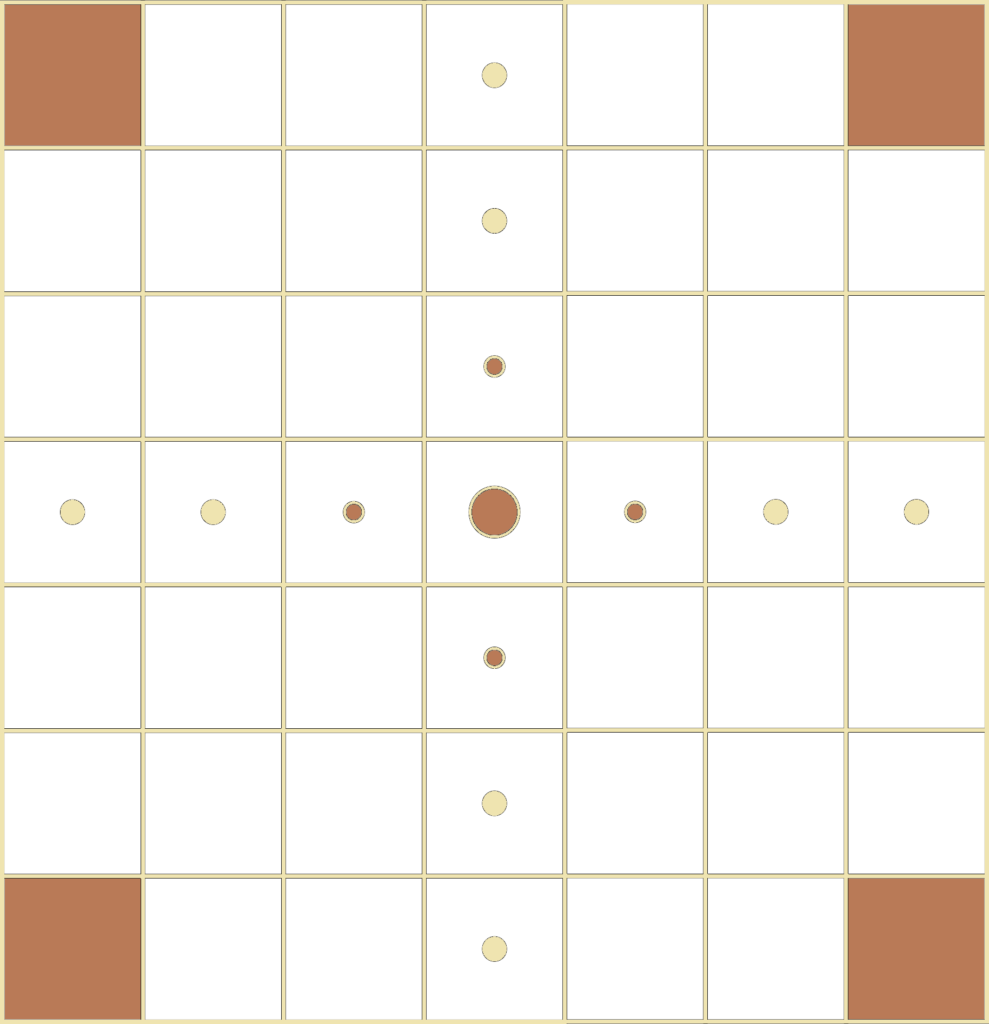
The king is placed in the “throne” which is the center square of the board, each of the king’s guards (the pawns of the same color as the king) are placed in the 4 spaces adjacent to the king in a cross.
The attackers are placed so that they extend the cross to the edge of the board, 2 pieces on each side, as shown in the diagram.
Game Play
- Each player, starting with the attacker, takes turns moving their pieces.
- Movement: Each piece, including the king, moves in the same way. The pieces can move any number of open spaces horizontally or vertically without jumping any other pieces (like a rook in chess).
- Special Squares: The center square, or throne, and the 4 corner squares are only available to the king, no other piece is allowed to occupy them. You may, however, pass through the throne during your move. You just can’t land there. Once the king leaves the throne, he is not allowed to return to it.
Capture
- Pieces, including the king, are captured by surrounding the piece on opposite sides, or by trapping the enemy between one of your pieces and a corner square.
- Captures are always made horizontally or vertically, never diagonally
- You may use the king as one of your pieces to capture an enemy.
- You may move your piece between 2 enemies without being captured. A piece is only captured if the opponent initiated the move.
- Multiple pieces may be captured in a single turn.
Declaring the Winner
- If the king escapes to a corner space, the King player wins!
- If the king is captured, the attackers win!
- If either player cannot make a legal move, it’s a draw.
A note on the accuracy of historic game rules:
Most ancient games and historic games were originally taught by word of mouth, so there can be many different interpretations to the rules. This is just one version that you can play. There are other variations that you can try until you find your favorite, but this will get you started. Just make sure that when you play with other people who are familiar with the game, you agree on a set of rules before you start to avoid any hard feelings.