
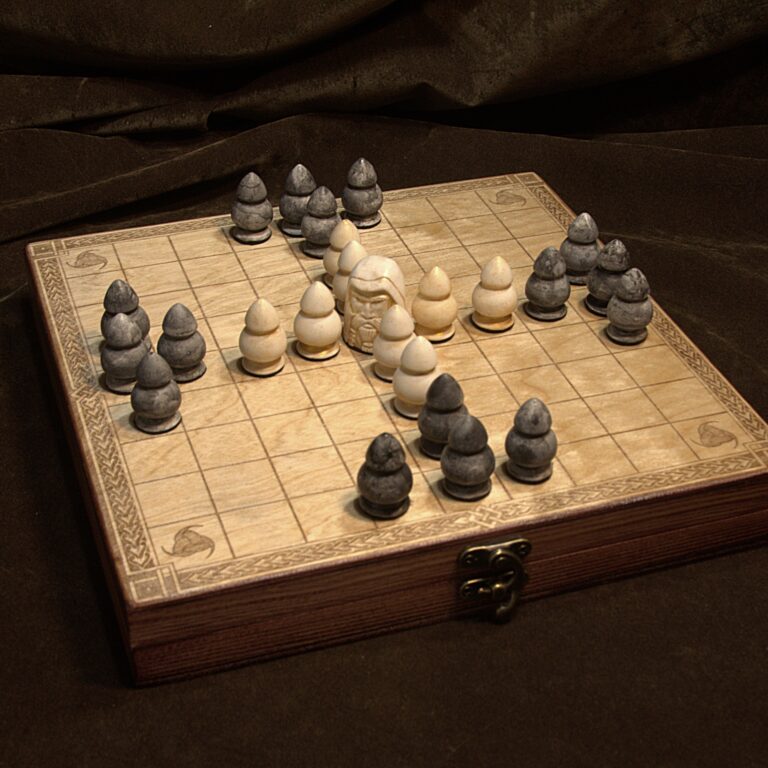
History
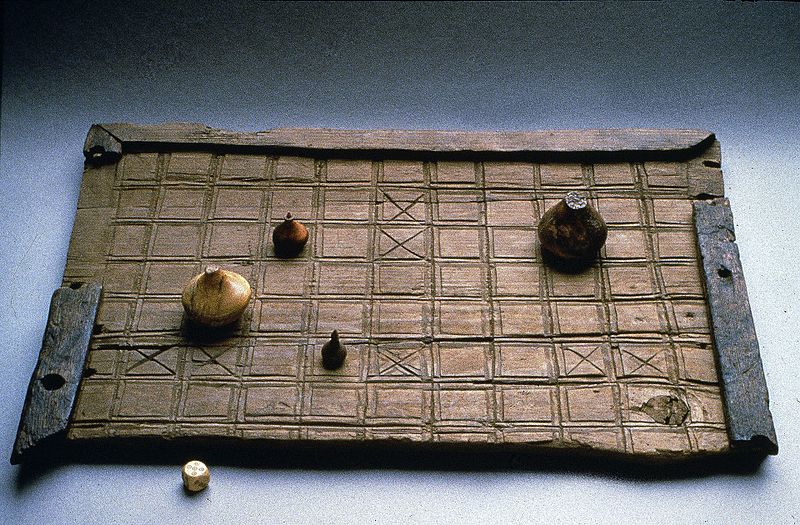
Tablut is one of many variations of the “tafl” family of games. Tafl games are played on a grid, and are characterized by asymmetrical game play, which means each player has a different number of pieces, a different setup, and a different goal.
These games fall into the larger category of “war games” which include other popular games such as chess and checkers. Evidence of tafl games dates back to around 400 AD.
This family of games includes the Norse game Hnefetafl which was played by the ancient Vikings. As with many aspects of viking culture, Hnefetafl spread to other parts of Europe over the centuries and evolved as it was adopted by other cultures.
The game play of Tablut is very similar to Hnefetafl, however the board has a smaller grid, being only 9×9. Because of this, the setup is more compact, and requires fewer pieces. Tablut was first documented in 1732 by a Swedish botanist named Linnaeus. According to his description the theme of the game is of a Swedish King who is defended by his loyal guards. They attempt to get him to safety while they fend off an attack by the Muscovites.
How to play
Objective
The object of the game for the defending player is to get his king to one of the 4 corners of the board. The goal for the attackers is to capture the king.
Setup
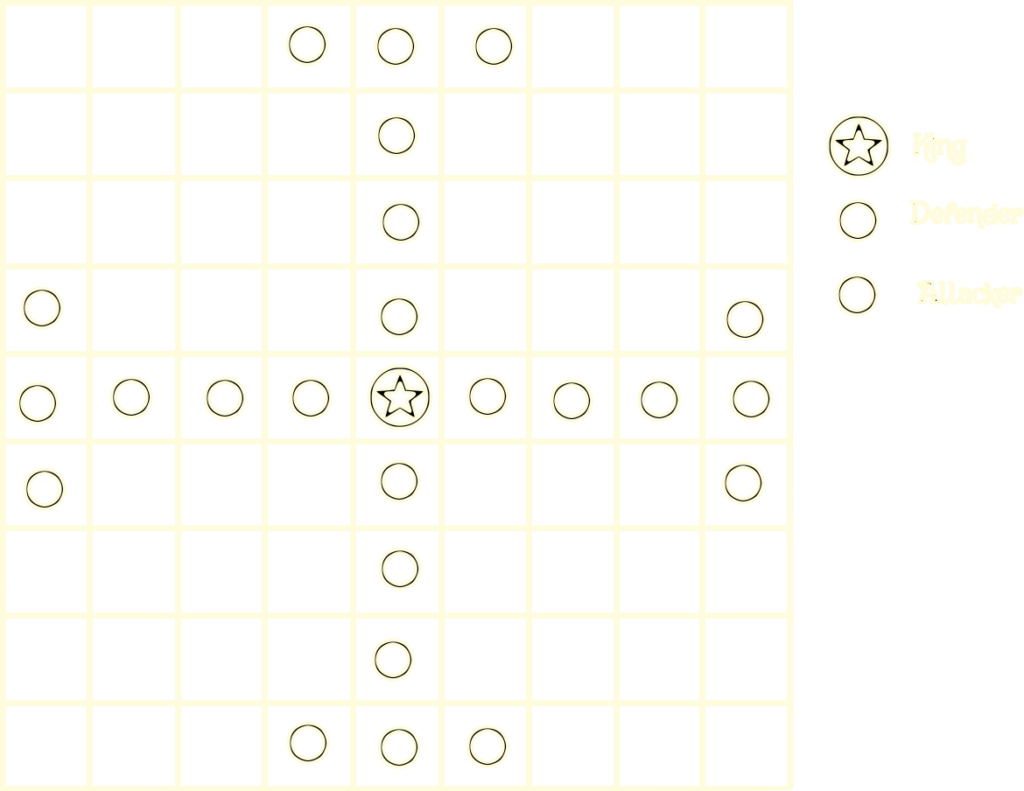
Each player has a different set of pieces. The player on the attacker side will have 16 matching pieces, and the defender will have 8 defenders and 1 king.
The board is set up with the king in the center square and the defenders in a cross shape surrounding him.
The attackers form 4 triangles, centered on each edge of the board as you see in the picture.
General Rules
- The attacker moves first, and each player takes turns moving one piece at a time.
- All pieces, including the king, can only move orthogonally (not diagonally) in a straight line. (similar to a rook in chess) They can move any number of squares as long as another piece is not in the way. They can't jump over other pieces.
- The central square is called the Throne, and no piece may occupy it except the king.
- This came uses "custodian capture", meaning that pieces are captured by surrounding them. Pawns are captured when an opponent surrounds them on 2 opposite sides orthogonally. (diagonally doesn't count)
- The king must be surrounded by all 4 sides in order to be captured. Or if the King is on the edge of the board or adjacent to the throne, he is captured if he is surrounded on the remaining 3 sides.
Declaring the Winner
- If the king is captured, the attackers win!
- If the king reaches one of the 4 corners of the board, the defenders win!
A note on the accuracy of historic game rules:
Most ancient games and historic games were originally taught by word of mouth, so there can be many different interpretations to the rules. This is just one version that you can play. There are other variations that you can try until you find your favorite, but this will get you started. Just make sure that when you play with other people who are familiar with the game, you agree on a set of rules before you start to avoid any hard feelings.