
History
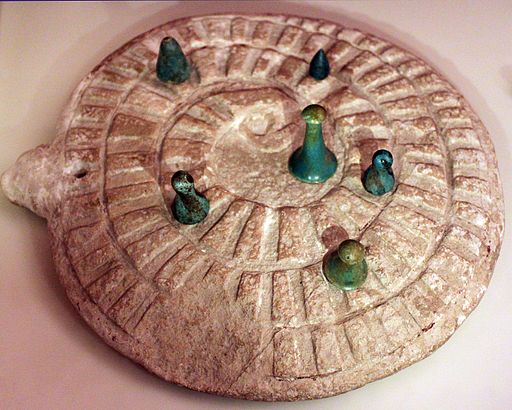
Mehen is one of the oldest board games ever found. It dates to pre-dynastic Egypt to around 3000 BC. The name Mehen is that of a snake that accompanies Ra in his nightly voyage through the underworld. He is a protective deity, and assists Ra in his battles against another snake deity named Apep.
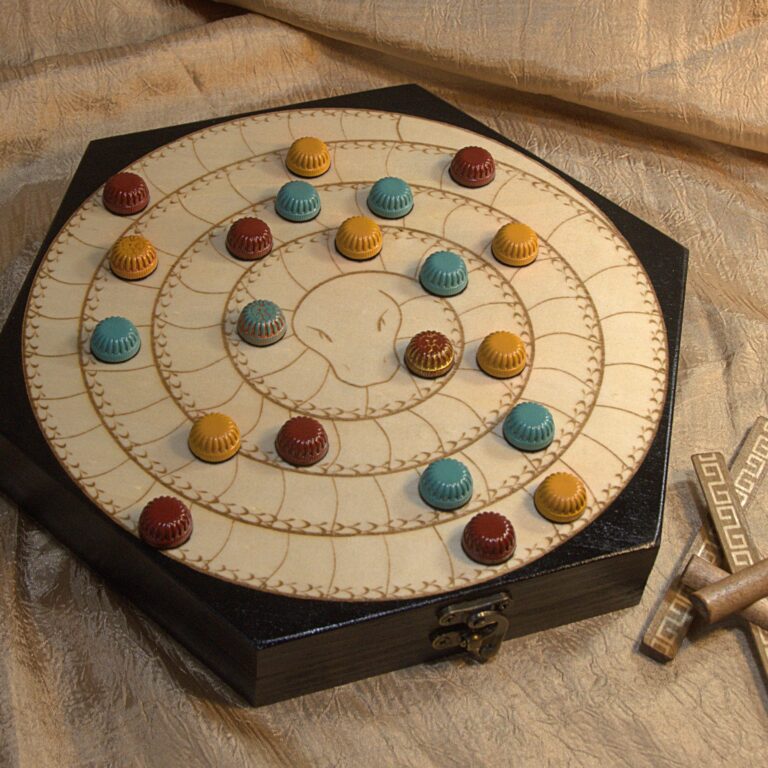
Artifacts found for the mehen game usually have a snake depicted on the board, with varying numbers of spaces. The pieces usually include small pawns and larger pieces – often shaped like lions. Based on the number of pieces from artifacts so far, it’s assumed that this game can accommodate up to 6 players.
The original rules of the game have been lost to history, but archaeologists and historians have been able to piece together a set of potential rules through research and discoveries of similar known games of the time period in that region. The version of the rules listed here are based on another game known as the hyena game. The premise of the two games are different, but the mechanics and setup are very similar. In fact, you can actually play the hyena game with the Mehen sets that are sold in this shop. This is just one of many other variations out there that you can also try.
How to play
Overview
The game is played in 2 phases. First, the players must get all of their pawns to the center. At that point they will release their lion, and they make their way back to the tale of the snake.
The lion is able to eat an opposing player’s pawns on the way. The game ends when there are no more pawns left on the board: all the pawns are either back to safety or eaten. The winner is the person whos lion has eaten the most pawns.
Setup
Each player places their lion in the center of the board (on the snakes head) and the other pieces are kept off the board.
Phase 1
- Hold the casting sticks vertically and drop them to the table. The number of sticks shown with the decorated side up determines how many spaces to move
1 stick = 0 spaces
2 sticks = 2 spaces
3 sticks = 3 spaces
4 sticks = 4 spaces
0 sticks = 5 spaces
- You must cast a 1 to move a piece onto the board. Place your piece onto the first space.
- If you rolled a 1, you can choose to one of the following actions: Place a piece onto the board, move a piece forward 1 space, or save the 1 for later (you can keep a tally on a piece of paper or using small items as counters).
- If you roll any other number, and you already have pieces on the board, move one of your pieces toward the head of the snake.
- Two pawns may not occupy the same square.
- Pawns must move toward the head of the snake in this phase.
- When you get to the head of the snake you must enter by exact count. If you have any saved 1s that you casted earlier, you may choose to add one of them to your move now. (You can only use one per turn)
- You must get all of your pawns to the into the head of the snake before you can release your lion.
Phase 2
- Once all of your pieces have made it to the center, you may now release the lion and move all of your pawns back to the tail of the snake.
- Lions move the same way as pawns, except that if they land on a square occupied by another player's pawn, you capture the other player's piece.
- Lions can not eat other lions, or occupy the same square as another lion or your own pawn.
- Lions can move in either direction, but pawns can only move towards the tail in this phase.
- The goal is to get as many pawns back to the tail without being eaten, and to have your lion eat as many opponents as possible.
- Just as with phase one, you may save your rolled 1's for later use.
- The final space on the tail must be entered by exact number, similar to the head of the snake.
- Once you reach the final space you remove the piece from the board. That piece is safe from being eaten by any lions.
- The game is over when there are no more pawns on the board.
Declaring the Winner
- Each player counts the number of pieces that their lions captured, the winner is the person with the most captured pieces.
- Tie-breakers are given to the person with the highest number of pawns that made it back to the safety without being eaten.
A note on the accuracy of historic game rules:
Most ancient games and historic games were originally taught by word of mouth, so there can be many different interpretations to the rules. This is just one version that you can play. There are other variations that you can try until you find your favorite, but this will get you started. Just make sure that when you play with other people who are familiar with the game, you agree on a set of rules before you start to avoid any hard feelings.