
History
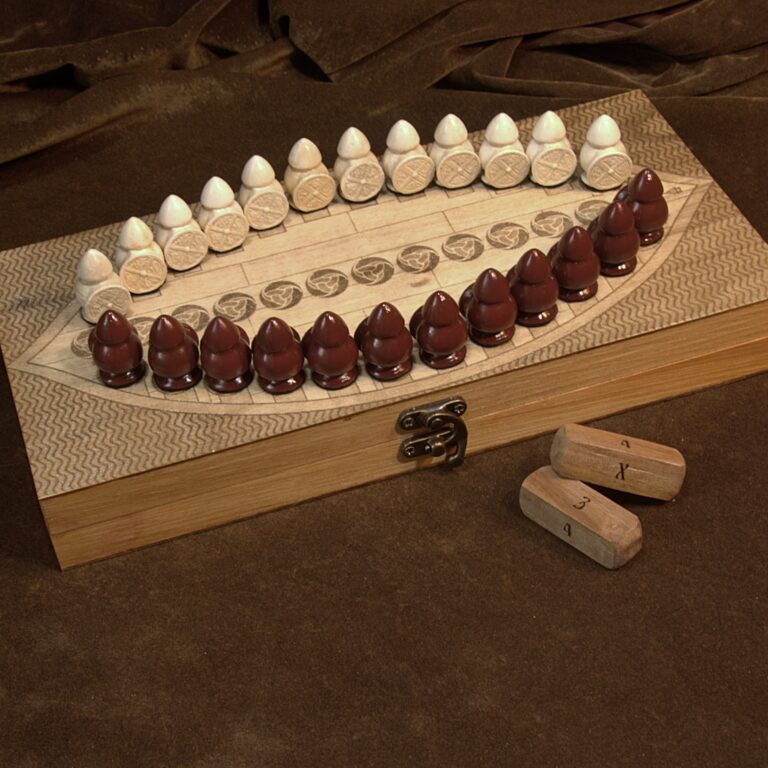
Daldøsa and Daldøs are running fight games from Scandinavia. Daldøsa is the version played in Jæren, Norway, and Daldøs is from Denmark. The difference between the two variations is that Daldøsa is played with 12 pieces for each player, whereas Daldøs is played with 16 each. The dice also use a different symbol for “activating” a piece (X vs A).
The history of Daldøs(a) is mysterious. It could date as far back as Medieval times, or it could be a more modern invention from the 18oo’s. Daldøs(a) bears a similarity to other race games such as Tâb and Sîg of north Africa, or Tablan of India. However, there is no historical evidence to tie the games together, so it is currently unknown if Daldøs(a) was a direct descendant of these games, or if the similarities are a coincidence. It has been speculated that Vikings imported games from Africa or the Middle East and adapted them, but there is no definitive proof.
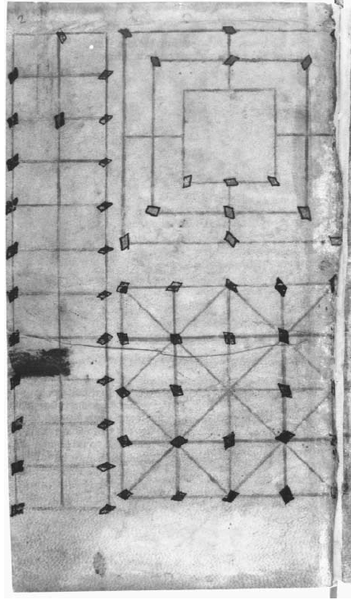
The earliest written evidence of this game is from a novel written in 1876 by J. P. Jacobsen. There are earlier examples and drawings of similar game boards, however due to the similarity to other games, it’s difficult to tell if those artifacts are specifically Daldøs(a) games. One notable example was recovered from the wreckage of the Mary Rose warship from 1545. The lid of a barrel was carved with gameboards for 9 men’s morris (a very common game in medieval times) and a game board could likely be Daldøsa as it has the right number of spaces, and a triangle that may have indicated direction. There is also a manuscript from Cerne, UK in 1248 with illustrations of several known games alongside an unknown board that could possibly have been Daldøs(a).
How to play
Objective
Each player is battling to take control of the ship by capturing all of your opponent’s pieces until they have one piece left.
Setup
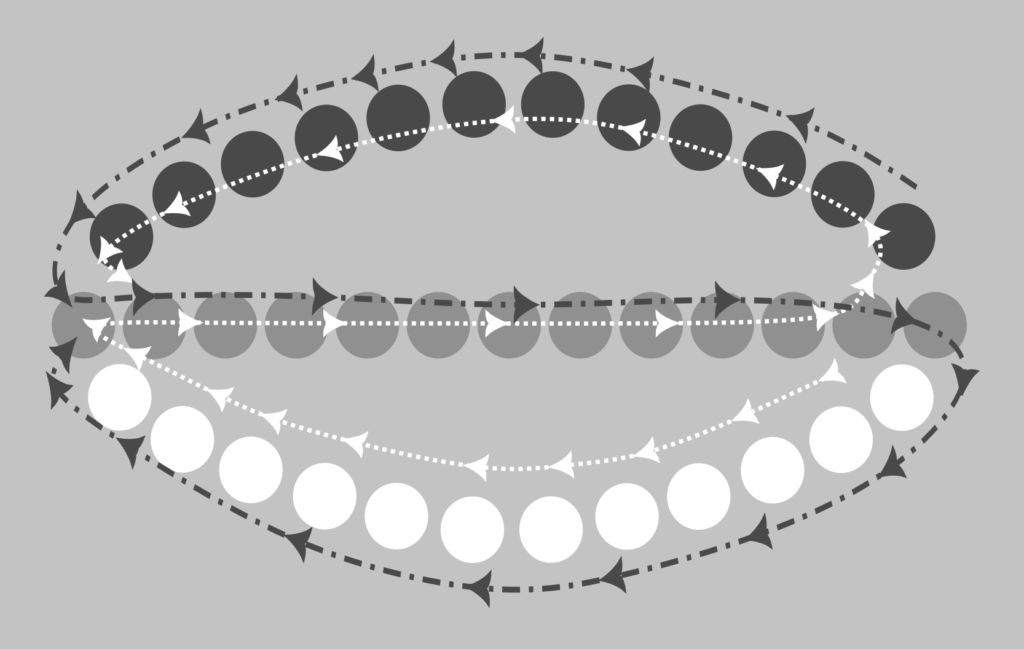
The board is placed between the players horizontally. The row that is closest to the player will be their home row. Place each of your pieces in the spaces in your home row facing toward the center row.
During game play the pieces will either be active or inactive, this is indicated by the direction that the pieces are facing: inactive pieces will face the center row, and active pieces will face the direction of travel. All pieces should be inactive to start.
General Rules
- The direction of travel is mirrored for each player. Once a piece is activated, it moves out of your home row at the stern of the boat (follow the arrows on the board), through the center row, then into their opponents home row from the front of the boat. From here they continue back through the middle row. You will never re-enter your home row. (see diagram)
- Players must roll an “x” to activate a piece before it can be moved. This is called “dal”. When you throw a dal, turn the first inactive piece toward the direction of play according to the arrows on the board. Pieces will not be allowed to pass or jump over each other, so they must be dalled in order.
- If you land on an opponent’s piece, that piece is captured and removed from the board. You may capture enemies that are not yet dalled. You may not land on your own piece, or pass/jump any of your own pieces.
- When players roll the dice, each die is counted separately. You can use both dice to move one piece twice or move two separate pieces.
- Rolling 2 dals (x’s) gives you an extra turn.
- If you are unable to move any of your pieces, your turn is over.
During your turn
- Each player should roll one of the dice, the player with the highest number goes first.
- Take turns rolling the dice. If you roll an “x” you may dal (activate) one of your pieces by turning it in the direction of travel, or you move a piece that is already active 1 space. Other numbers on the dice can be used to move active pieces the number of spaces shown on the dice.
- You can choose to split the two dice rolls between two pieces.
Declaring the Winner
The winner is the first player to capture all of their opponent’s pieces except one. At that point the losing player surrenders and the game is over.
A note on the accuracy of historic game rules:
Most ancient games and historic games were originally taught by word of mouth, so there can be many different interpretations to the rules. This is just one version that you can play. There are other variations that you can try until you find your favorite, but this will get you started. Just make sure that when you play with other people who are familiar with the game, you agree on a set of rules before you start to avoid any hard feelings.